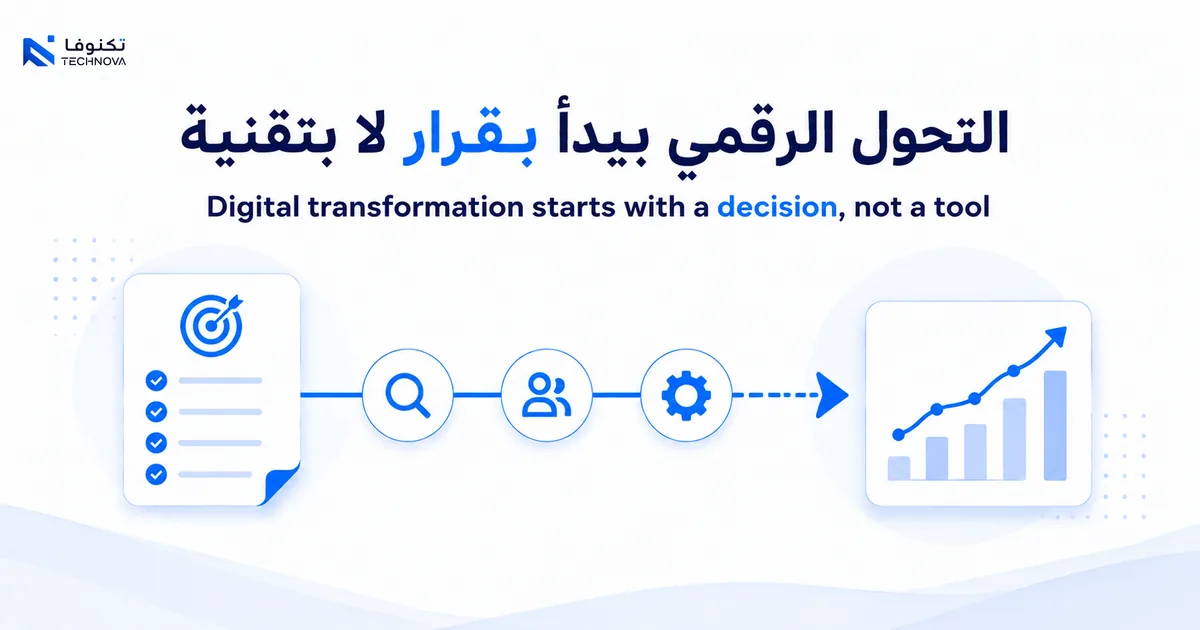
Saudi businesses turn Vision 2030 priorities into digital products when they start from one clear operational decision: which process drains your team's time and hides your data? You build a single product around it and measure its impact with a number. Successful digital transformation does not start with technology — it starts with a specific, measurable problem, then scales on evidence, not ambition.
In this guide: how to identify a digital priority from Vision 2030, how to choose the first product to build, how to measure its success, and the mistakes that stall transformation before it begins.
What does digital transformation actually mean for a Saudi business today?
Digital transformation is not buying a new system. It is redesigning how the company works around data and decisions.
Vision 2030 has pushed entire sectors toward digitisation — from retail to logistics to financial services and tourism. But regulatory pressure alone does not create a successful transformation.
The companies that succeed start with one operational question before any tool: where are time and data being lost today? That answer is the starting point, not the choice of technology.
Sectors do not transform at the same pace. Retail and financial services usually start with the customer interface, while logistics and manufacturing start with internal process automation first. Identifying your sector helps you know where impact comes fastest.
How do you turn a Vision 2030 priority into a specific digital project?
Do not start from a broad statement like "we want digital transformation." Start from one measurable process. The criteria that identify the right priority:
- The process repeats daily and consumes a whole team's time.
- Its data is spread across separate sheets, files, and systems.
- Every report on it requires manual effort and repeated consolidation.
- A single error in it costs the company a client, a deal, or a commitment.
The process that meets three of these four is the right starting point — it is the highest in impact and the clearest to measure.
How do you choose the first digital product to build?
The rule: one product that solves one problem, not a full platform built all at once.
Start with an MVP (Minimum Viable Product) — the smallest usable version that solves the core problem and proves value before scaling.
- Define the user first: an internal employee or an external customer?
- Define the single required outcome: less time, fewer errors, or more sales?
- Choose between automating an internal process via CRM (Customer Relationship Management) or ERP (Enterprise Resource Planning), or a customer-facing product.
- Build what can be measured within weeks, not months — proving value fast protects the budget.
The first product is not the biggest, but the clearest in impact. Its success is what funds the next step.
How do you measure the success of digital transformation?
Transformation without measurement is spending without evidence. Before launch, define KPIs (Key Performance Indicators) — numbers that tell you whether the product is actually working.
- Time saved in the process after digitisation versus before.
- The rate of manual errors before and after.
- The speed of producing a report that used to take hours.
- User satisfaction — the internal employee or the end customer.
A good indicator is specific and tied to the process itself, not generic like "improved performance." A number that cannot be linked to a decision is not worth tracking.
Distinguish between a leading indicator that moves first, such as active users, and a lagging indicator that appears later, such as revenue. The leading indicator warns you before it is too late; the lagging one confirms the result. You need both for a sound reading.
When do you build a custom solution and when do you buy off-the-shelf?
Not every transformation needs building from scratch. Buying is sometimes faster and cheaper, and sometimes it limits you and forces you to change how you work.
The decision depends on the nature of the process itself, not on your technical preference. A standard process where every company looks the same does not deserve a custom build, while a process that creates your edge deserves full control.
Buy an off-the-shelf system (SaaS - Software as a Service) when the process is standard like accounting or email, you need a fast start at low upfront cost, and you do not mind adapting to how the system works.
Build a custom solution when the process is your competitive advantage, no ready-made system truly fits how you work, or you need deep integration with your existing systems.
The practical rule is simple: buy what is common to every company, and build what makes your company unique. Many successful solutions are a mix of both.
How do you plan the digital transformation budget?
The common mistake is to set aside a huge budget for one large project, then spend it before any result appears. Gradual transformation allows smarter budget planning.
Split spending across phases, each with a measurable result. The phase that proves its value funds your confidence in the next, and the one that fails is stopped before its loss grows.
Also calculate the opportunity cost: how much does keeping the old process cost you monthly? Sometimes the cost of not modernizing is greater than the cost of doing it.
And do not forget the hidden costs: training, data migration, and the parallel-running period. The budget you ignore is the one that surprises you later.
Do not wait for the perfect budget to start. Begin with the smallest phase that proves value; an early result opens the budget more than any plan on paper.
How do you prepare your team to adopt the new tools?
The best system fails if the team rejects it. Adoption is half the success of transformation, not a final step left to chance.
The resistance you see is often not stubbornness, but fear of the unknown or of losing the skill earned on the old system. Handle it early with involvement and training.
- Involve users in the design early, not after launch.
- Train the team on the tool before it goes live.
- Start with a small group that tests and gives feedback before rollout.
- Explain "why" it changed, not only "what" changed.
- Assign an internal owner to answer the team's questions in the first weeks.
A new tool succeeds when the team feels it eases their work, not that it was imposed on them from above.
What mistakes stall transformation before it begins?
- Starting with technology before defining the operational problem.
- Trying to digitise everything at once.
- Buying an off-the-shelf system that does not truly fit how the company works.
- Launching without measurement indicators agreed in advance.
- Neglecting to train the team on the new tool, so it is abandoned within weeks.
Each of these turns transformation from an investment with a return into a cost with no result.
Where do you practically start in the first two weeks?
Transformation does not start with a big budget, but with small steps you can act on immediately.
- Sit with the team and list the three processes that consume the most weekly time.
- For each, ask: where is its data stored today, and how many manual reports does it require?
- Choose one process only — the most frequent and the clearest to measure.
- Write the target outcome in one sentence and one number that measures it.
- Set Discovery as the first step before any build — to understand the process before digitising it.
An illustrative example: a retail company spends two days a month manually consolidating a sales report from several branches. Target outcome: cut consolidation from two days to one hour. The number that measures it: report preparation time. That is a clear starting point, not a "full digital transformation."
Start with that one process. Its measured success is what builds the confidence and budget for the next step.
Related links
- The markets we serve across the region
- Process automation and CRM/ERP systems
- When does your business need a custom ERP?
If you have a specific process draining your team's time and hiding your data, talk to the Technova team about turning it into a digital product measured by a number.