You choose the right software company in Egypt when you decide by criteria, not promises: documented experience in your problem, understanding your business before the technology, and past work you can verify. There is no single company that fits everyone, only the one most suitable for your need, stage, and budget. The right decision starts by defining your need precisely, then measuring each company against clear criteria.
In this guide: why the decision is hard, how to define your need, evaluation criteria, reading past work, pre-signing questions, red flags, contract protection, comparing offers, local vs offshore, post-delivery support, and managing the relationship.
What makes choosing a software company in Egypt a hard decision?
The Egyptian market is crowded with companies ranging from small teams to large firms, and quality varies sharply between them.
Most of them say the same thing: high quality, competitive prices, wide experience. These phrases do not tell one company from another.
And the decision is costly. A wrong choice means lost months, a burned budget, and a product that does not work. You need a way to measure substance, not the pitch.
With no unified quality rating in the market, the burden of telling companies apart falls on you. Build your own way of evaluating.
The answer is not the biggest name, but the most suitable for you — known by criteria you apply, not by a claim you hear.
How do you define your need before searching for a company?
The first mistake is searching before you know what you want. Clarity on your side reveals the right company quickly.
Write your need in the language of the outcome, not the solution. Say "I want to cut customer-service time" rather than "I want an app"; a good company will then propose what fits your goal.
Before any meeting, define:
- The problem you are solving and the outcome you want to reach.
- Do you need a new product, developing an existing system, or maintenance?
- Your approximate budget and an acceptable timeframe.
- Who will follow the project on your side after signing?
The clearer your request, the harder it is to sell you what you do not need, and the easier it is to compare offers on one basis.
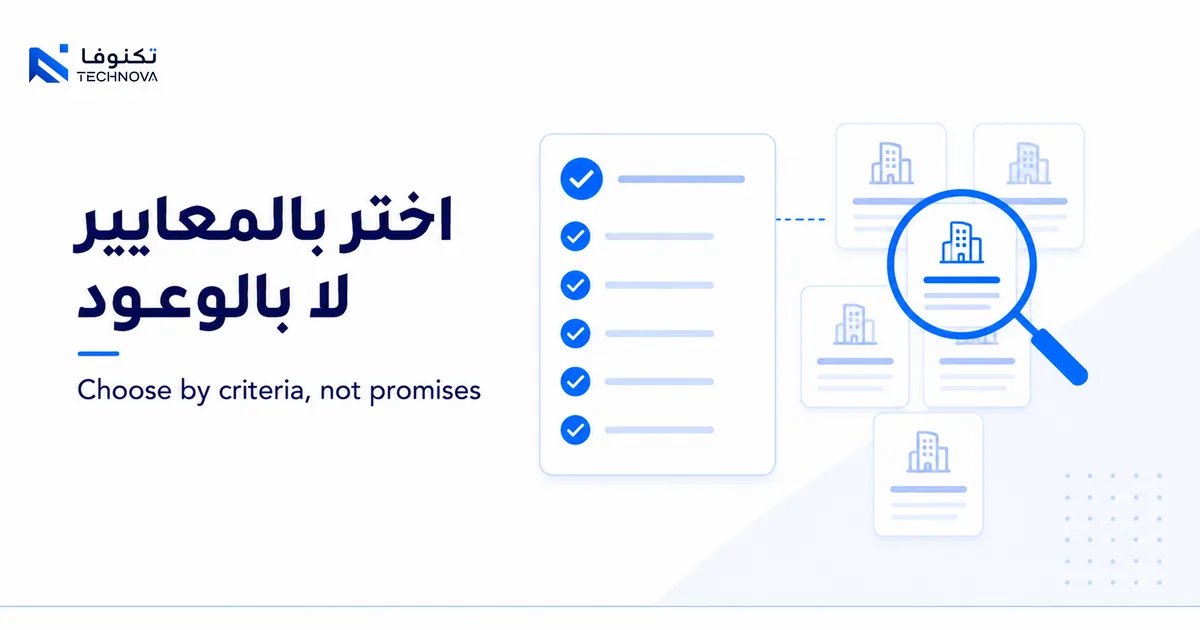
What criteria do you measure any software company by?
Instead of asking "who is strongest?", ask "who meets these criteria?"
- Documented experience in a problem similar to yours, not general experience.
- Understanding your business and asking about your goals before talking technology.
- Real past work you can verify and whose owners you can contact.
- Clarity in how they work, communicate, and phase the project.
- A stable team where you know who will actually work on your project.
- The ability to support and maintain after delivery, not deliver and disappear.
Treat these as a balance to weigh with, not a checklist to tick. A company strong in experience and weak in communication may cost you more than a balanced one.
A company meeting most of them is more suitable than a famous one that does not. Criteria protect you from being dazzled by a name.
How do you read a company's past work intelligently?
A portfolio tells you more than any presentation, but only if you read it critically.
Do not settle for a pretty look. Ask: does this project resemble yours in size and complexity, and is it still working?
- Ask for projects in your field or of similar size, not just the nicest work.
- Verify the project is real and live, not just a design that was never built.
- Contact a past client and ask honestly about the experience.
- Note the company's role: did it build the project or only take part?
The shiny work may have been built by a team that has since left. Ask who built it, and whether they still serve you.
What questions do you ask before signing?
Good questions reveal a company more than any pitch. Ask before you sign:
- Who exactly will work on my project, and what is their experience?
- How do you handle it when the project is delayed or the scope changes?
- Who owns the code and data after delivery?
- What happens after launch — support, maintenance, development?
- How will you communicate with me, how often, and how clearly?
Listen to how they answer, not only what they say. A company that asks you questions back is closer to understanding your business.
What red flags reveal an unsuitable company?
Some signs appear early, before they cost you. Watch for them in the first two meetings.
- Exaggerated promises about speed or price without understanding your problem.
- Avoiding specific questions and replying with general talk.
- Refusing to give a reference or a past client to contact.
- Vagueness about who will actually work on the project.
- A contract without clear detail on scope, delivery, and ownership.
Do not ignore your feeling in the meeting either. Repeated vagueness, or a rush to close, matter as much as any clause.
How do you protect your project in the contract?
The contract is your line of defence when the two sides disagree. Read it slowly before you sign.
What protects you most is a precisely written scope: what the project includes and excludes, and how out-of-scope changes are counted.
- Ownership of code and data is clearly yours after full payment.
- Delivery phases tied to payments, not one full payment upfront.
- A clear definition of what counts as "completed delivery" for each phase.
- A clause for post-delivery support, its duration and cost.
- A fair mechanism to end the contract if things do not go well.
A company refusing to clarify these clauses reveals itself early.
How do you compare offers without being fooled by price?
The lowest offer is not the most economical, and the highest is not the safest. Price alone misleads.
Compare value against cost. A lower offer with a missing scope may cost you more later in changes.
- Make sure the offers cover the same scope before comparing their prices.
- Ask what is not included (support, changes, hosting).
- Beware a very low price — it often hides a missing scope.
- Weigh price against the other criteria, not in isolation.
Ask for the scope in writing before comparing numbers. The gap may be in what each offer includes, not in the company's value.
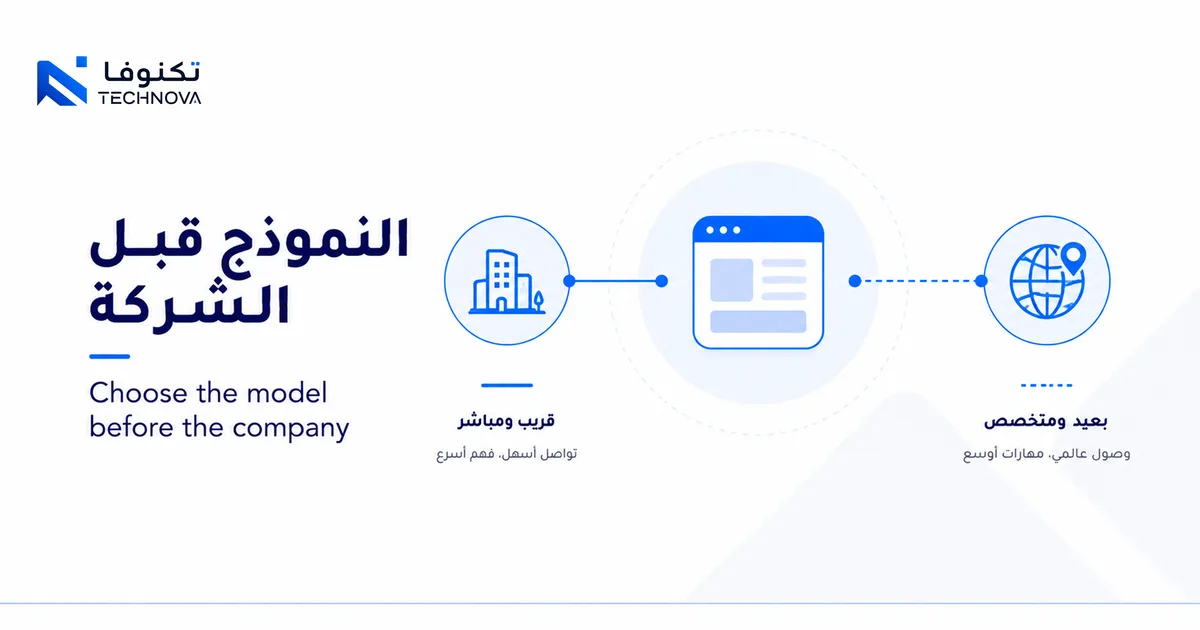
A local company in Egypt or an offshore one?
Proximity has value, but it is not the only rule.
A local company is closer in language, culture, and timing, and easier for meetings, follow-up, and solving problems face to face.
Offshore may offer a rare specialisation or a different cost, but it demands more discipline in communication and time zones.
For most Egyptian-market companies, local proximity reduces friction. Choose offshore when you need expertise you cannot find locally.
How do you make sure the company stays with you after delivery?
A digital product does not end at launch. It needs maintenance, updates, and support when a problem appears or your need changes.
A company that delivers and disappears leaves you alone at the first failure. Ask about support before signing.
- Is there a clear support agreement with a known duration and cost?
- How long do they take to respond when something breaks?
- Does the company document the code so another can continue it if needed?
Staying with you after delivery is part of a company's value, not an extra service. Make it a factor from the start.
How do you manage the relationship after signing to succeed?
Choosing the company is half the road. The other half is how you manage the relationship afterwards.
- Assign one owner on your side to follow the project continuously.
- Agree on clear phases, each with a reviewable delivery.
- Review progress regularly instead of waiting for the end.
- Write down what you agree on; do not rely on verbal talk.
Agree early on how changes will be handled. Projects always change, and companies differ in how clearly and fairly they manage that.
The strongest company fails with absent follow-up, and an average one succeeds with clear management on your side.
Where do you practically start?
- Write your need and target outcome on one page.
- Prepare your list of criteria before any meeting.
- Meet at least three companies and compare them on the same criteria.
- Verify past work and contact a real client.
- Read the contract carefully, especially scope, ownership, and support.
An illustrative example: a business owner wants an internal management system. Instead of taking the lowest offer, they write their criteria, meet three companies, and check a past client for each — choosing the most suitable and saving months of rework.
Related links
- Product discovery and MVP build
- The markets we serve across the region
- Offshore or a local partner: what to choose?
If you are evaluating a company for your next project, talk to the Technova team to discuss your need and criteria before you decide.