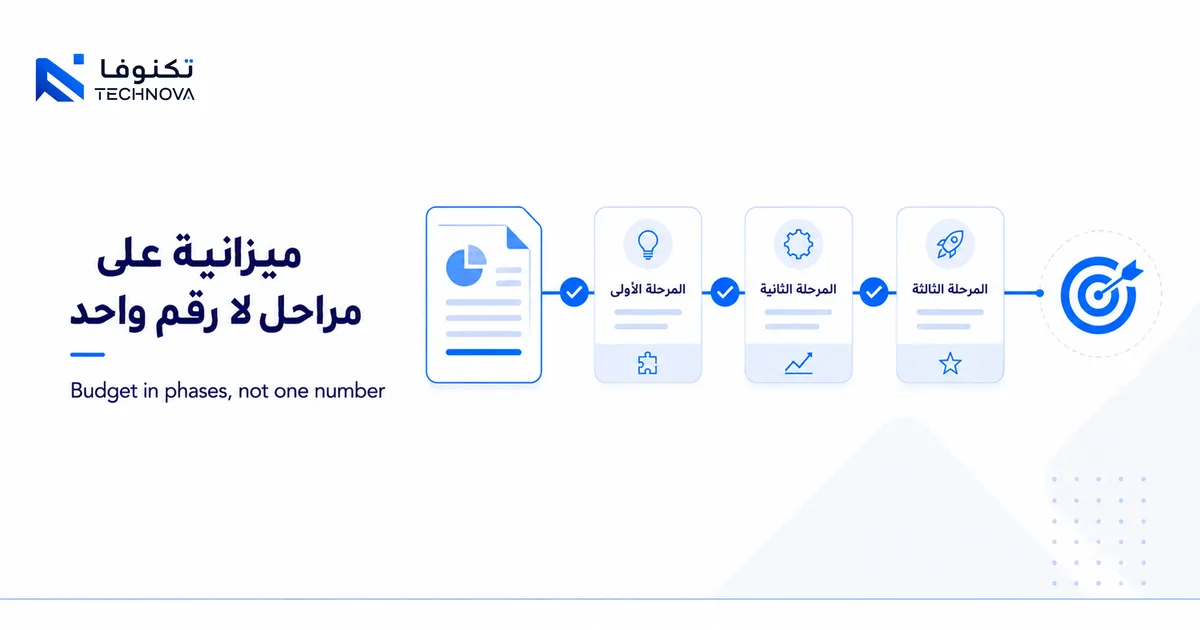
You plan your software project budget by turning it from one number into clear line items: discovery, design, development, testing, launch, then ongoing operation after delivery. The common mistake is budgeting for the build alone, then being surprised by costs you never counted. A good budget is split into phases, and each phase proves its value before the next.
In this guide: what makes up the budget, hidden costs, why projects overrun, phasing, contingency, running cost, tying budget to return, what to defer, and negotiating.
What does a software project budget actually consist of?
The budget is not the development price alone. A project is a chain of phases, each with its own cost.
- Discovery: understanding the problem and defining scope before building.
- Design: user experience and interfaces.
- Development: building the actual features.
- QA: making sure what was built works as it should.
- Launch: deployment, setup, and migration from the old system.
- Operation: hosting, maintenance, and support after launch.
When you request a quote, ask for it itemised across these. A quote that gives you one number hides more than it shows.
Itemising helps twice: it reveals what is actually included, and it lets you adjust scope item by item instead of cancelling the whole project.
Which costs are most often forgotten?
Most budget overruns do not come from development, but from items nobody counted at the start.
- Hosting and cloud services monthly.
- Third-party services: payment gateways, messaging, maps, email.
- Migrating data from your old system.
- Training your team on the new system.
- Your internal team's time in follow-up and review.
- Post-launch changes based on user feedback.
These items are small alone, but together they form a considerable part of the real cost.
Because most appear after signing, asking about them early is the cheapest way to protect your budget.
Ask the company directly: what is not included in this quote? The answer reveals what you will pay later.
Why do software projects overrun their budget?
Overrun is usually not bad luck, but the result of repeated causes you can avoid with planning.
The first cause is a scope that is not precisely defined. When a project starts from a general description, both sides discover details during delivery, and each discovery adds time and cost.
The second is changing requirements without clear management. Change is natural in software, but undocumented change becomes uncounted rework.
The third is ignoring non-development costs: testing, data migration, training, and operation after launch.
- A precisely written scope before starting.
- A clear mechanism to manage and price changes.
- Counting non-development items from day one.
- Reviewing the budget after each phase, not at the end.
Knowing these causes turns the budget from an optimistic estimate into a manageable plan.
How do you split the budget into phases?
Committing the whole budget to one large project means risking all of it on an untested assumption.
Phasing turns one large risk into small sequential risks, each of which can be stopped.
- Start with discovery: it costs little and protects the rest from a wrong scope.
- Fund one phase at a time with a reviewable result.
- Tie payments to specific deliveries, not to elapsed time.
- Review after each phase: continue, adjust, or stop?
The first phase deserves special care, because it shapes everything after it. A precise scope early saves the cost of every later phase.
How much do you leave as contingency?
Every software project meets something unplanned. The difference is that whoever planned a contingency does not stop at the first surprise.
Leave part of your budget unassigned to any item, to cover variables: a requirement that appeared late, an integration harder than it looked, or user feedback worth building.
Decide in advance who owns the decision to spend it and on what criteria, or it gets consumed on small details before the real need.
What is the cost of running the product after launch?
Launch is not the end of spending, but the start of a new kind. A live product needs an ongoing budget.
- Hosting, domain, and certificates.
- Maintenance and fixing failures.
- Security updates and system libraries.
- Technical support for your users.
- Incremental development based on usage feedback.
Ask about the annual running cost before signing, not after launch. A product without an operating budget degrades gradually until it stops.
How do you tie the budget to expected return?
The more important question is not "how much does it cost?" but "what does it return?" A budget without an expected return is just spending.
Before approving any number, define what will change in your business after launch, and how you will measure it.
- Time saved for your team weekly.
- Manual errors reduced, and their cost with them.
- Customers you can serve without growing the team.
- Decisions made faster because data is available.
When you tie cost to an operational result, the decision becomes clearer: is this item worth what it returns?
How do you know the estimate is realistic?
A very low estimate is not an opportunity but a risk signal. It usually means a missing scope or incomplete understanding.
A realistic estimate comes after questions, not before them. A company that prices without asking is guessing, and guessing shows up later as changes.
- Did they ask about expected users and data volume?
- Did they ask which systems it will integrate with?
- Did they break the estimate into phases or give one number?
- Did they state the assumptions behind the estimate?
An estimate built on written assumptions can be reviewed and adjusted. A number without assumptions cannot be questioned.
What do you defer when the budget is limited?
A limited budget does not mean a weaker project, but a smarter scope. The difference is in what you choose to defer.
Keep what proves the core value, and defer what can be added later without rebuilding.
- Start with the core function that solves the original problem.
- Defer excessive customisation and multiple options.
- Use ready services for standard parts instead of building them.
- Defer advanced reporting until you know what users actually need.
What is never deferred: security, data quality, and basic usability. Saving on these costs you multiples later.
How do you negotiate the budget without lowering quality?
Good negotiation does not squeeze the price; it reshapes the scope. Ask to reduce what is delivered, not the quality of what is delivered.
Ask: which item can be deferred to the next phase without affecting the value of the first launch?
Avoid asking for a discount in exchange for nothing. A discount without a scope change is usually recovered as less time or less senior attention on your project.
How do you present the budget to partners or your board?
A good budget needs a good presentation. Many sound projects are rejected because they were presented as a cost, not an investment.
Present the problem first with its operational impact: what it costs the company today in time, errors, and missed opportunities.
Then present the solution split into phases, with a decision point after each. This reassures the approver, who is not committing to everything at once.
- Start with the problem and its current cost, not the technology.
- Present the first phase with its cost and expected result.
- Explain how you will measure success and when.
- Show what happens if nothing is done.
The decision becomes easier when the approver sees a gradual path with stopping points, not an open commitment with no exits.
Where do you practically start?
- Write the outcome you want and the problem it solves.
- Ask for an itemised quote, not one number.
- Ask directly what is not included.
- Set aside a contingency and decide who approves spending it.
- Count the annual running cost within the decision.
- Split the budget into phases tied to deliveries.
When counting items, count your internal team's time too. Reviews, meetings, and content decisions are all real costs even if they never appear in a quote.
An illustrative example: a company wants an internal management system on a limited budget. Instead of building every feature, it starts with the module consuming the most team time, measures the impact, then funds the next module from the return.
The governing rule: a good budget is neither the largest nor the smallest, but the one split into phases that each measure their return before committing to the next.
Related links
- How to choose a software company in Egypt?
- When to start with an MVP and when to build the full product?
- Product discovery and MVP build
If you are planning the budget for your next project, talk to the Technova team about matching scope to your budget before you start.